San Diego Zoo
- 4.6
- Rating
- 100.00K
- Installs
- Free
- Price

 Analysis by App-foxy
I approached San Diego Zoo as an educational companion rather than a simple collection of animal pictures. It is a free app from the San Diego Zoo, designed around exploring one of the best-known zoos in the world from a phone. That focus gives it a clear identity: it is most useful when you want to turn curiosity about animals into a more guided visit, a quick learning session, or a way to prepare before going out.
My overall impression is positive, especially for families, casual learners, and visitors who want their phone to add context instead of becoming the entire activity. The app has a 4.5 average from around 955 ratings, with more than 100K installs, which suggests that it has found a steady audience. It is also rated for Everyone, so its subject matter is approachable for children as well as adults.
How the app feels when the connection is doing the work
The most important thing to understand is that this is a connected mobile experience. When the network is available, the app makes more sense as a living window into the San Diego Zoo: you open it, move through its material, and use your phone to explore rather than relying on a printed guide or a general web search. That can be especially handy when a child suddenly asks about an animal and you want to follow the question immediately.
You May Also Like

 Blood Strike: 2.5 Anniversary
Blood Strike’s Loadouts Turn Every Drop Into a Tactical Gamble
A close look at Blood Strike’s custom loadouts: how fast access to signature weapons reshapes its battle royale rhythm, rewards preparation, and narrows the gap between fights.

 Pandora - Music & Podcasts
Pandora’s Music Is Easy to Start, but Harder to Recover
Pandora’s strength is its low-effort path from a seed to a station. Its weak spot is how much confidence it asks you to place in connection, setup, and quiet recovery.

 8 Ball Pool
 Is Built on Rivalries, Rematches, and Routine
A close look at the rivalries, rematches, shared routines, and unanswered safety questions that turn a quick pool match into a persistent mobile community.

 Samsung Music
’s Quiet Strength Is Playing What You Already Own
Its reach comes less from spectacle than from dependable access to a personal library. That simplicity is both the app’s strongest retention engine and its ceiling.

 AccuWeather: Weather Radar
AccuWeather Review: A Quick, Clear Forecast for Everyday Decisions
For everyday plans, the best forecast is the one you can understand quickly. AccuWeather makes rain timing, radar, and local conditions easy to act on, with a few trade-offs.

 Hill Climb Racing
Why Hill Climb Racing Still Turns Crashes Into One More Run
A tiny car, a bumpy hill and one more upgrade: Hill Climb Racing keeps resurfacing because its simple chaos makes every near-miss feel personal.
More From Our News Desk



In my experience, network-dependent moments are also where expectations need to stay realistic. A zoo app is often used while walking, standing among crowds, or moving between areas where reception can vary. Pages or media that need to load may feel less immediate than they would at home. I would not treat it as a guaranteed replacement for signs, staff guidance, or a paper backup during a busy visit.
That does not make the app inconvenient by definition; it simply changes how I would use it. Before leaving home, I would open the sections I expect to need and become familiar with the layout. During the visit, I would use it for short checks rather than planning to keep the screen active continuously. This approach reduces the frustration of trying to discover everything for the first time while surrounded by noise, movement, and a weak signal.
The app’s educational value benefits from this same connected format. Instead of treating animals as isolated entries, I can use a question as a starting point: a child notices a species, we look it up, and the visit becomes a conversation. That is more memorable than scrolling through unrelated facts at random. Still, the experience depends on how smoothly the content reaches the phone at the moment I want it.
Useful before a visit, not only during one
I think the strongest workflow begins before arriving at the zoo. A short preview can help a family decide what everyone most wants to see, which matters when younger children tire quickly or when a group has different interests. It also gives adults a chance to set expectations: the phone is there to support observation, not to distract from the animals.
For a classroom or home learning session, the app can work as a focused prompt. I would choose one animal or theme, ask a child to describe what they already know, and then use the app to guide the next questions. The useful trick is to avoid handing over the phone without a goal. A simple task such as “find one detail we did not know” turns browsing into active learning.
Another practical use is preparing a return visit. Rather than opening the app only when standing at the entrance, I would use it to refresh interest beforehand and create a small list of priorities. That makes the phone part of the preparation process, where connectivity is usually more dependable, instead of making every decision on the move.
What changes on a moving phone
On a mobile device, the experience is naturally more interrupted than it would be on a desktop. I may hold the phone with one hand, share it with a child, put it away to watch an animal, and bring it back several minutes later. That is why I value short, purposeful interactions more than long reading sessions here.
Families should also think about who controls the device. A child may want to tap through everything, while an adult may be trying to keep the group together. I found that the app works better when one person acts as the guide and invites others to look at specific moments. It is less effective when everyone is expected to stare at the screen while walking.
For solo visitors, the app can be a quieter reference tool. I could pause beside an exhibit, check the relevant material, and continue at my own pace. The trade-off is that a phone can make the visit feel more mediated. If my goal is photography, observation, or simply being present, I would use the app sparingly and let the physical zoo remain the main event.
Its Everyone age rating makes it suitable for shared use, but suitability is not the same as independence. Younger children may need help reading, navigating, or deciding what information matters. I would not assume that the app alone creates a complete lesson; its best role is as a conversation starter supported by an adult, teacher, or older sibling.
What happens when loading does not go smoothly
Connectivity problems are not just technical annoyances in this setting. They can interrupt a child’s attention at exactly the wrong moment, especially after you have promised to show something. My practical response would be to avoid promising instant access. I would say that we can try to look it up, then keep the observation going if the screen takes too long.
A good recovery habit is to return to what is physically in front of you. Animal behavior, markings, movement, habitat design, and questions from the group can all keep the visit useful while the phone is set aside. This is one reason I see the app as an enhancement rather than the foundation of the experience. If it pauses, the zoo itself still provides the subject matter.
At home, recovery is easier because I can close and reopen the app without managing a moving group. I can also give the content more attention and compare what I saw with what I remember. If an item did not load during the visit, I would make a note and revisit it later instead of repeatedly refreshing the phone in front of an exhibit.
The current version is 3.4.19, and the app supports devices running Android 5.0 or later. That broad operating-system reach is useful for people who keep an older phone as a family device, although actual smoothness can still depend on the handset, browser components, signal, and the type of content being accessed. I would check compatibility before a planned outing rather than discovering a device issue at the gate.
Using it without wasting mobile data
Because the app is free, the main cost question is not an entry price for the software; it is how heavily I choose to use it while connected through mobile data. I would avoid leaving it open and repeatedly loading material just to fill time. Short sessions, deliberate searches, and closing it when the group is watching an animal are sensible habits.
Families sharing one phone can be more data-conscious by deciding in advance what they want to explore. A child can choose a question, the adult can open the relevant content, and everyone can discuss it before moving on. That is more rewarding than letting several people browse aimlessly, and it keeps the app from competing with the visit.
At home, I would do the exploratory part on a reliable connection and use the zoo visit for confirmation and observation. This division also makes the app more educational: first build curiosity, then look for evidence in the real environment. It is a small change, but it prevents the phone from becoming a constant loading screen.
I would also be careful with battery use. Any app used repeatedly during a long outing can contribute to a low battery, particularly when the screen stays bright or the device is already busy handling network activity. I would keep interactions brief, lower screen brightness when practical, and carry the usual backup power if the phone is also needed for tickets, messages, maps, or photos.
Where it fits among other education apps
Compared with a general animal encyclopedia, this app has a more specific sense of place. A broad reference tool may offer wider coverage and more structured study features, while San Diego Zoo gives the subject a direct connection to a real institution and a real visit. I prefer the latter when the goal is to make a trip feel more meaningful.
Compared with a normal web search, the app should feel more focused because I am not starting with a page of unrelated results. That focus is valuable for children, who can easily be pulled into distracting content elsewhere. The trade-off is flexibility: a search engine may answer an unusual question more quickly or lead to deeper material outside the zoo’s scope.
Compared with a printed guide, the app is easier to update and more engaging for someone who learns through a screen, but paper is dependable when a signal is weak and does not compete with battery life. I would not insist on choosing one. For a full-day visit, a simple printed plan or downloaded personal notes can complement the app, especially for families who want fewer interruptions.
Compared with a dedicated classroom platform, it is less likely to replace a teacher’s sequence of activities, assessments, or long-form lessons. Its strength is immediacy and connection to the San Diego Zoo, not formal curriculum management. Teachers can use it as a prompt, but I would pair it with their own questions and discussion rather than expecting a complete lesson plan.
Who will enjoy it most, and who should skip it
I would recommend it to parents who want to encourage animal interest without turning a zoo trip into a lecture. It is also a good fit for visitors who like a little context before looking at an exhibit, and for children who respond well to discovering information together with an adult.
It makes particular sense for a planned visit. If I know I am going to the San Diego Zoo, the app has a clear job: help me prepare, guide some questions, and add educational texture while I am there. That purpose gives the connected experience a reason to exist.
I would be less enthusiastic for someone seeking a complete offline field guide, a highly structured science course, or a broad animal database unrelated to the zoo. I would also skip it as a primary choice if I wanted a completely screen-free outing. In those cases, a book, printed guide, or general reference app may fit better.
People with limited mobile data should use it selectively rather than assuming every moment needs a connection. The free price removes a barrier to trying it, but it does not remove the practical limits of signal, battery, or attention. Those trade-offs matter more on a crowded day than they do during a quiet session at home.
My practical routine for getting more from it
My preferred routine is simple. I would explore the app before the visit, choose a small number of questions, and avoid trying to cover everything. During the outing, I would stop at a relevant exhibit, observe first, and use the phone second. Afterward, I would return to anything that raised a new question.
The most useful non-obvious tip is to make the app a prompt for noticing details rather than a substitute for noticing them. Ask a child to predict what an animal will do, examine the exhibit, and then use the app to continue the discussion. This creates a stronger memory than reading a fact without connecting it to what was seen.
A second tip is to assign the phone a role within the group. One adult can handle navigation while another keeps children engaged, or one child can become the “question finder” for a short stretch. That prevents constant grabbing and makes the shared device feel like part of the activity instead of a source of arguments.
A third trade-off is to separate discovery from documentation. If I try to read, photograph, message, and navigate at the same time, the experience becomes scattered. I would use the app for one clear purpose, put the phone away, and give the animals my full attention. This is where the app works best: in short bursts surrounded by real observation.
Final connectivity verdict
San Diego Zoo is a worthwhile free education app when I treat it as a connected companion to curiosity and a real-world visit. Its strongest quality is the way it can turn a child’s spontaneous question into a shared learning moment, while its main weakness is that mobile conditions are not always ideal for uninterrupted exploration.
The developer, San Diego Zoo, has given the app a clear audience rather than trying to be every kind of education tool. I like that focus. It is approachable, suitable for Everyone, and available to a large existing audience, but it still asks users to plan around reception, battery, attention, and data.
My recommendation is to install it before a planned zoo visit, explore it on a reliable connection, and use it in short, intentional sessions outdoors. If you want a dependable offline reference or a complete course, choose another tool. If you want your San Diego Zoo experience to include a little more context without losing the animals themselves, this app is an easy one to try.
FAQs for San Diego Zoo
01What features does the San Diego Zoo app offer?
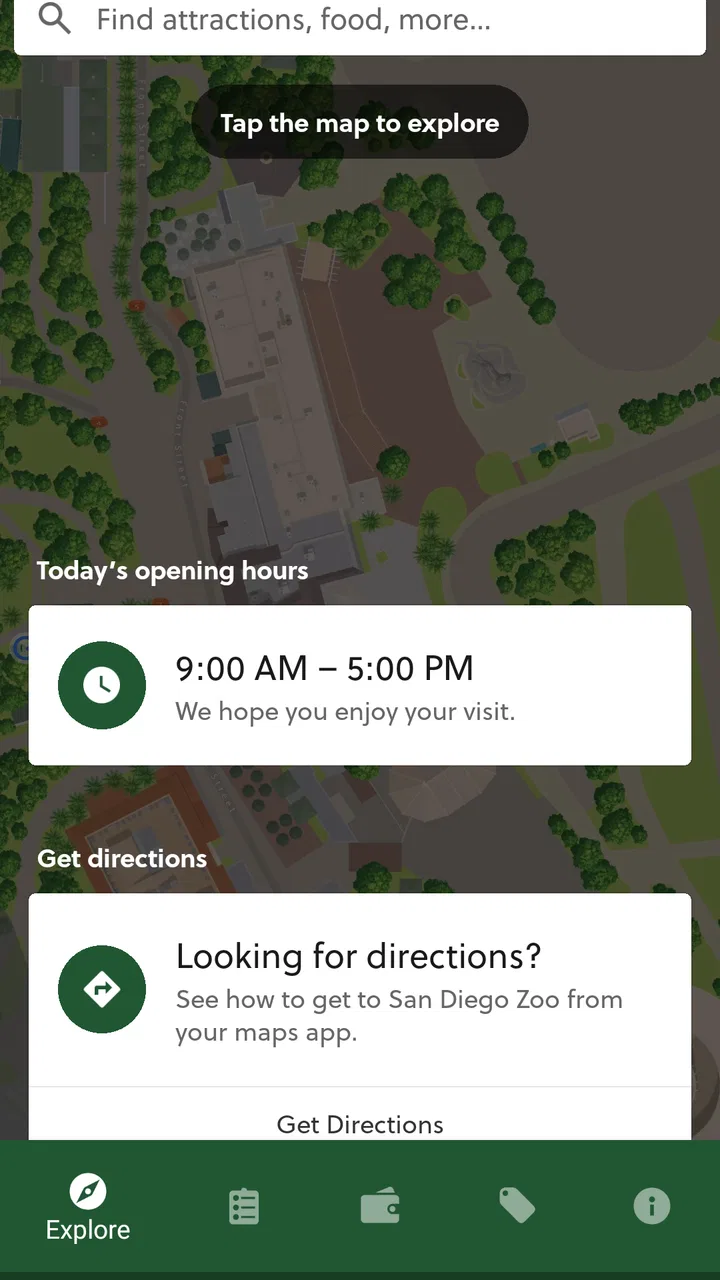
The San Diego Zoo app provides a comprehensive guide to the zoo, including an interactive map, animal facts, and show schedules. Users can also access the latest zoo news and events, purchase tickets, and plan their visit with customized itineraries. It's a handy tool for both first-time visitors and regulars.
02Is the San Diego Zoo app available on both Android and iOS?
Yes, the San Diego Zoo app is available for download on both Android and iOS platforms. Users can easily find it on the Google Play Store for Android devices and the Apple App Store for iOS devices. The app is optimized for both operating systems, ensuring a seamless experience.
03Does the app require an internet connection to function?
While many features of the San Diego Zoo app can be accessed offline, such as the map and basic animal information, an internet connection is required for real-time updates like show schedules and news. To fully enjoy all functionalities, it's best to have an internet connection during your visit.
04Is there a cost to download or use the San Diego Zoo app?
The San Diego Zoo app is free to download and use. However, certain features such as purchasing tickets or exclusive content may require additional payment. It's designed to enhance your visit without any hidden charges, making it accessible to all zoo visitors.
05How user-friendly is the San Diego Zoo app for first-time users?
The San Diego Zoo app is designed with user-friendliness in mind, featuring an intuitive interface that makes navigation easy for first-time users. The app includes clear instructions and helpful tips to guide users through its features, ensuring a smooth and enjoyable experience from start to finish.
Pros
- Engaging educational content for all ages.
- High-quality videos and live cams of animals.
- User-friendly interface with easy navigation.
- Regular updates with new animal features.
- Supports conservation efforts through awareness.
Cons
- Requires an internet connection for full features.
- Some features may lag on older devices.
- Limited offline content for remote access.
- Subscription needed for premium content.
- Notifications can be overwhelming at times.

San Diego Zoo
Gallery